
The Hybrid Meeting Problem

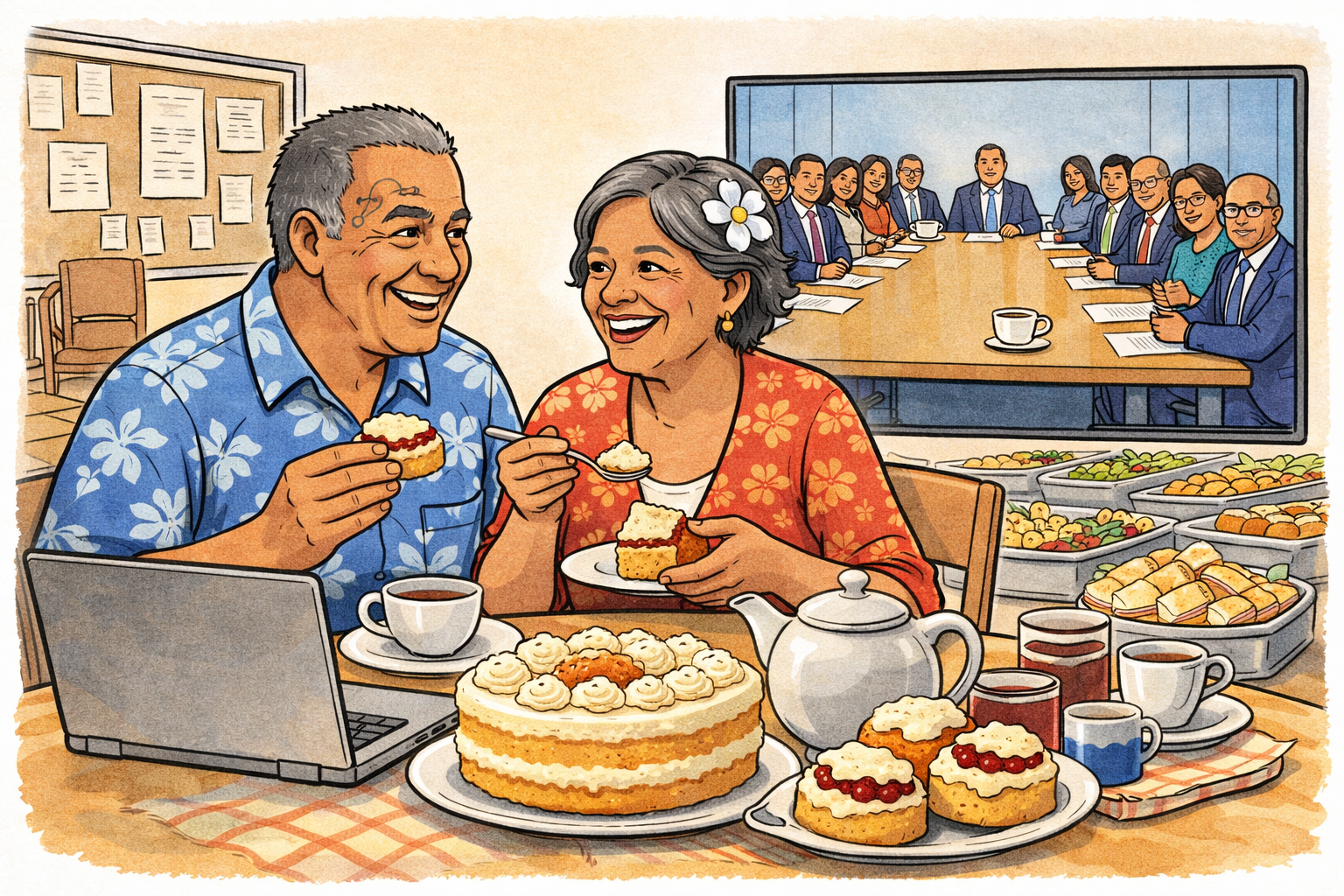
Hemi & Mereana always enjoyed it when it was their turn to provide supper for the parish meeting.

At some point in the last few years, most church committees discovered hybrid meetings.

Someone’s away.  Someone’s unwell.  Someone lives two hours away and would quite like not to drive at night.

So we say, quite reasonably:  “We’ll just make it hybrid.”

And for a while, it feels like a small miracle.  More people can attend.  Fewer apologies.  The meeting goes ahead.

It looks like inclusion.

And then, slowly… something shifts

You’ve probably seen it.

The people in the room start talking.  Not rudely — just naturally.  They can see each other.  They can read the room.  They build on each other’s ideas.

Meanwhile, on the screen:

  • someone unmutes just a fraction too late 
  • someone starts speaking and gets talked over 
  • someone decides it’s easier to stay quiet than interrupt 

And the meeting moves on.

No one’s been excluded. 

But not everyone has really been included either.

More than missing the biscuits

When you join a meeting remotely, you don’t just miss out on the coffee and biscuits.

You miss the side glances. 

The pauses. 

The moment where someone leans forward and says, “Hang on — I’m not sure about that.”

You miss the rhythm of the room.

And in a governance setting, that rhythm is where influence lives.

The problem we don’t name

Hybrid meetings don’t just change where people are.

They change how participation works.

And that matters most in the places we tend to care about most – the moments of discussion, discernment, and decision.

Because governance isn’t just about being present.  It’s about being able to contribute.

Where hybrid works beautifully

Before we throw the whole thing out — it’s worth saying this clearly.

Hybrid meetings are genuinely useful.

They work well for:

  • Information sharing — updates, briefings, reports 
  • Training and learning — where interaction is structured anyway 
  • Large gatherings — where not everyone is expected to speak 
  • Accessibility and participation — enabling people to be present who otherwise couldn’t be (but guardrails are needed …) 

In these settings, hybrid increases reach without significantly distorting the outcome.

That’s a good thing.

Where hybrid quietly struggles

The problems tend to show up when the meeting shifts from sharing to shaping.

  • testing ideas 
  • weighing options 
  • making decisions 
  • trying to reach consensus 

Because decisions tend to form where the conversation flows most easily.

And in hybrid meetings, that’s almost always in the room.

A polite fiction (and a governance risk)

Hybrid meetings create a very tidy story:  “Everyone was there.

And technically, that’s true.

But there’s a quieter question underneath it:

Did everyone have the same chance to shape what happened?

If the answer is “not quite”… – then we’ve moved from convenience into governance risk — even if no one intended it.

Why this keeps happening

It’s not bad behaviour.

It’s physics.  And people.

  • Sound takes a moment to travel 
  • Video adds a slight delay 
  • Interrupting a room you’re not in feels awkward 
  • Chairpersons naturally respond to the people they can see 

None of this is dramatic.  But it all adds friction.

And friction, over the course of a meeting, quietly redistributes influence.

This isn’t really a tech problem (but tech can help a bit)

Better microphones and cameras are useful.

But they don’t fix the core issue.

Because the problem isn’t whether people can connect. 

It’s whether they can participate on equal footing.

That said, some tools can reduce the gap slightly:

  • shared chat or Q&A tools (the introvert’s revenge) can give quieter voices a way in 
  • live polling can surface views that might not be spoken aloud 
  • structured digital feedback can slow things down just enough for remote voices to land 

These don’t replace conversation.

But they can help rebalance it — especially for those who find speaking up harder in any setting, not just online.

What can be done (without throwing the laptop out the window)

Hybrid meetings aren’t going anywhere.  Nor should they.

But they do need a bit more intentionality than we usually give them.

A few small shifts make a surprisingly big difference:

  • Flatten the room 
    If it’s an important discussion, consider having everyone join on their own device — even if they’re in the same building.  It feels odd.  It works.
    • Structure the conversation 
      Let’s hear from each person” isn’t overkill.  It’s inclusion made visible.
    • Watch the quiet voices 
      If someone hasn’t spoken, there’s usually a reason.  Good chairpeople notice that.
  • Separate discussion and decision 
    Talk together in hybrid.  Confirm decisions in a way that gives everyone equal voice — even if that’s a follow-up vote.

None of this is complicated. 

It’s just deliberate.

The uncomfortable bit

Hybrid meetings feel inclusive because they remove barriers to attendance.

But attendance isn’t the same as participation.

And participation isn’t the same as representation.

If we blur those together, we can end up with decisions that are technically shared… but practically shaped by whoever happened to be in the room.

Before your next meeting…

It might be worth asking one simple question:  “Will the people joining remotely be able to contribute as easily as the people in the room?

If the answer is “probably not”…  then the meeting needs a bit more thought before it starts.

Because good governance isn’t just about who’s present.

It’s about whose voice actually shapes the outcome.

One last thought

Hybrid meetings are a good tool.  They just aren’t a neutral one.

Used well, they open doors. 

Used casually, they can quietly narrow them again — just in less obvious ways.

So before your next meeting, take a moment.

Make sure you’re not leaving voices hanging at the end of the line.

Illustration created using AI image-generation tools for d|c|t.

Peter Lane is Principal Consultant at System Design & Communication Services and has over 30 years of experience with Technology systems.    We invite your questions, suggestions and ideas for articles.   These can be submitted either through the editor or by email to dct@dct.org.nz We also operate a website focused on building a community of people interested in improving how we use technology in churches, located at dct.org.nz  

Cartoon of stressed-out church volunteer managing tech at Sunday service

So, you need a new website?

Part of the Accidental Techie series, and the Parish Websites series.

At some point, many churches arrive at the same moment.

You realise you need a website — or a better one — and you’re not entirely sure how that decision got made, only that it now involves you.

Sometimes it’s obvious.

Sometimes it’s gradual.

Sometimes it arrives disguised as a perfectly innocent sentence like:

“Well… the website probably needs someone to look after it.”

Congratulations.  You are now the Parish Webmaster.  (There’s no badge.  Sorry.)

Before you panic, take a breath.  This happens all the time.  You don’t need to become a web expert.  You just need to build something sensible, survivable, and kind to the next person who inherits it.

What A Church Website Is Actually For

Let’s clear something up early.

A church website does not need to:

  • look trendy
  • update weekly
  • win design awards
  • impress other churches

It does need to do a few very ordinary things, very reliably:

  • help people find you
  • help them work out who you are
  • help them turn up at the right time and place
  • help them contact a real human

Think of it less as a magazine and more as a signpost. 

If it’s clear, accurate, and doesn’t fall over, it’s already doing ministry.

The Minimum Viable Church Website

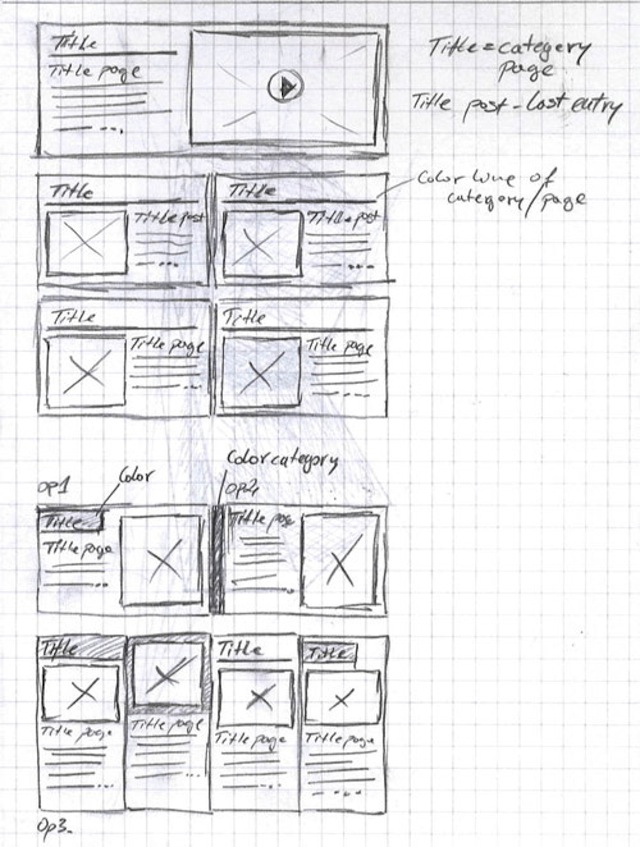
Sample handrawn wireframe diagram for a simple website

One of the biggest reasons people stall is because they think they need to build everything.

You don’t.

A perfectly respectable church website can be:

  • a small set of pages, or
  • a single, well-structured long-scroll page that covers the basics clearly.

Both are valid.  Neither is a shortcut.

In practice, the core content usually looks like this, whether it’s split across pages or sections on one page:

  • Home / Welcome – who you are and what sort of church this is
  • Service times and location – clearly, unambiguously, and correctly
  • About – a bit of story and context
  • Contact – how to reach someone who actually replies
  • (Optional) Events or ministries, if you genuinely use them

If all of that lives on one thoughtfully laid-out page, that’s fine.  If it’s spread across a handful of pages, also fine.

If your site never grows beyond this, that’s not a failure.  That’s a working system.

A Few Decisions You Only Need to Make Once

There are some decisions you can’t dodge — but the good news is that you only need to make them once and then stop thinking about them.

In particular, make sure your site has:

  • Backups
    Not because disaster is inevitable, but because humans make mistakes and computers are funny beasts.  A rewind button is holy.
  • Basic analytics
    Used gently, this answers simple questions like “Is anyone finding us?” and “On what device?”.  This is stewardship, not surveillance.  This information allows you to make your website better over time.
  • Clear access control
    Not everyone needs admin access.  Future-you will thank present-you.

If you do nothing else, do these things and move on.

Why WordPress Is a Sensible Default

There are lots of ways to build a website these days.  Some are quicker to start.  Some are shinier on day one.

WordPress is still a sensible default for churches because it does a very unglamorous but important job well:

  • it’s widely used and well supported
  • there are plenty of themes that assume boring but faithful content
  • it doesn’t require a full-time web team
  • it copes remarkably well with volunteer turnover

It’s not perfect.  But it’s forgiving.  And forgiveness turns out to be a surprisingly important design feature in church life.

Updates: Accuracy Comes First.  Everything Else Is Optional.

Before you worry about how often the website is updated, worry about whether it is correct.

If something changes —

  • service times
  • locations
  • contact details
  • people named on the site

… then the website should change too.  Now.

An out-of-date website doesn’t just look a bit sad; it quietly misleads people who are trying to find you.  That’s not great hospitality.

Once the basics are accurate, everything else becomes a strategy decision.

Ask two honest questions:

  • What are we actually trying to achieve with this site?
  • What can we realistically sustain?

If you decide:

  • monthly posts — then post monthly
  • quarterly updates — completely fine
  • occasional notices only — also valid

What matters is that you do what you said you would do.

A quiet, accurate, predictable website serves a parish far better than an ambitious one that runs out of steam after three enthusiastic weeks.

Rule of thumb:
under-promise and over-deliver.

You Don’t Have to Do This All at Once

“Building a website from scratch” sounds enormous, but in practice it’s a finite, learnable process.

Most of the fear comes from not knowing where to start, or from thinking you have to get everything right the first time.  You don’t.

A working website you understand is better than a perfect one nobody can maintain.

Help exists on a spectrum — from “sit next to me while I do this” to “please just handle it” — and it’s entirely reasonable to choose the level that fits your capacity right now.

If all you do this week is get the basics online and correct, that’s already faithful work.

If you’ve found yourself responsible for a website you didn’t ask for, you’re not alone.
This is doable. And you don’t need to lose your sense of humour — or your theology — along the way.

Peter Lane is Principal Consultant at System Design & Communication Services and has over 30 years of experience with Technology systems.    We invite your questions, suggestions and ideas for articles.   These can be submitted either through the editoror by email to dct@dct.org.nz We also operate a website focused onbuilding a community of people interested in improving how we use technology in churches, located at dct.org.nz  

Church + AI: We Want Your Story

We’re building something.

It’s called Church + AI — a guide to using artificial intelligence in faith-based and small-scale contexts.

Not a thinkpiece. Not a hype-fest. Not another ethics lecture (unless your story needs one).

Just something practical. Something grounded. Something that reflects what’s actually happening out there — from the Sunday service to the spreadsheet.

That’s where you come in.

If you’ve used AI in your ministry, community group, or small-but-mighty organisation — we want your story.

What worked?
What didn’t?
What surprised you?
What made you want to throw your laptop out the vestry window?

Stories can be about:

  • Preaching, liturgy or study
  • Rosters, planning or communications
  • Websites, media, or outreach
  • Anything else you tried, whether it succeeded or not

And yes — you don’t have to be a church to contribute.
If your organisation shares the same scale, constraints, or values — we’re listening.

Tell us your tale:

👉 dct.org.nz/church-ai

We’re not looking for polish. Just honesty.
(And maybe a little humour. We know what ministry life is like.)