

AI automations that even your AI chatbot thinks are risky
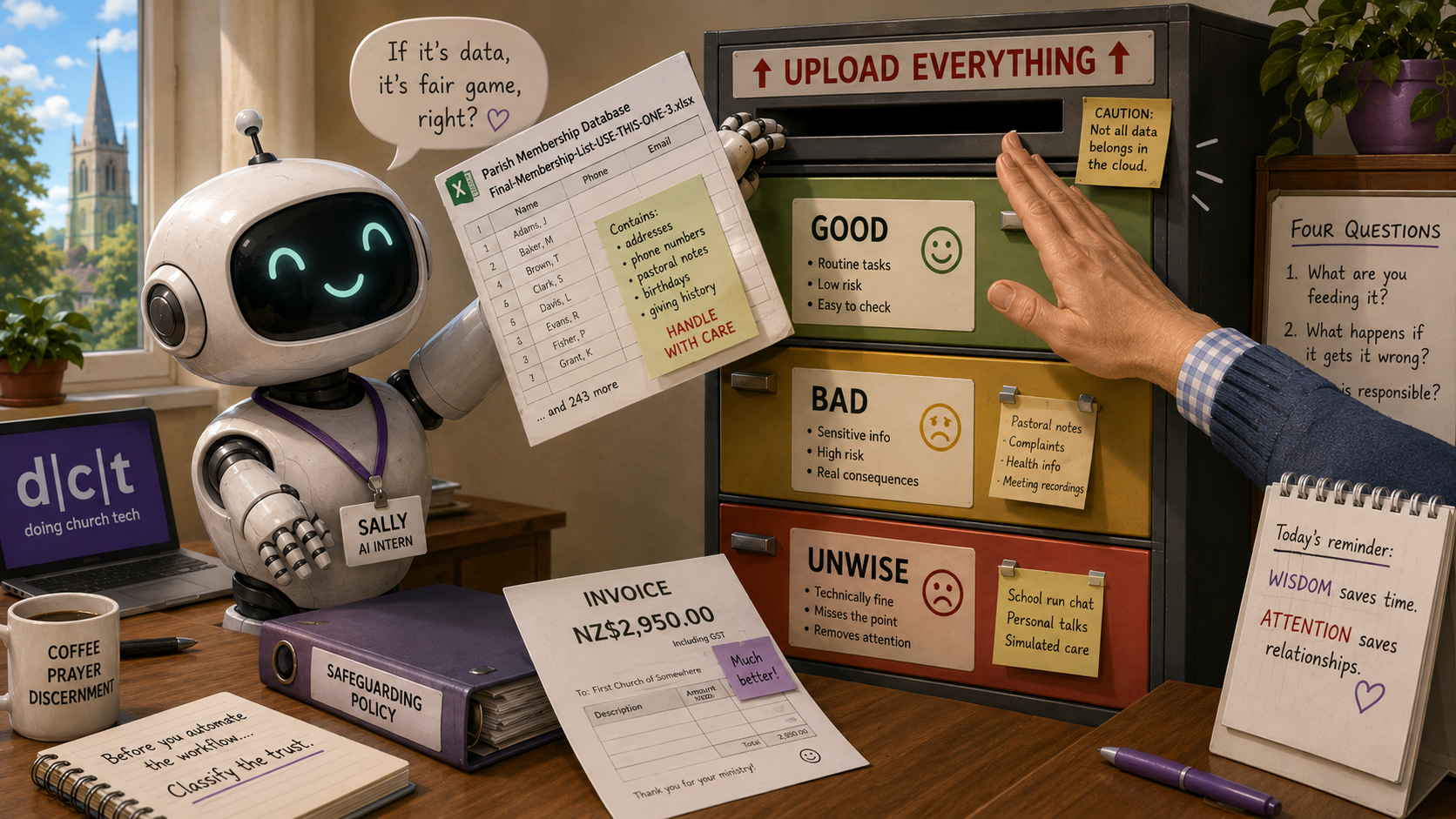
There’s no shortage of advice telling us what AI can do for us.
Sort your inbox. Summarise your meetings. Clean your spreadsheets. Personalise your emails. Draft your reports. Monitor what people are saying about you. Connect everything to everything else and reclaim hours of your life.
It all sounds marvellous.
Churches are particularly vulnerable to these lists because they’re short of time, short of volunteers and surrounded by repetitive administration. “Automate this” sounds like grace descending from the cloud — although, regrettably, it usually wants access to your contacts first.
Sally, Peter’s AI intern
The problem isn’t that all these automations are bad. Many are genuinely useful.
The problem is that “Can AI do this?” is usually the least interesting question.
The better one is:
Should AI do this — using this information, in this setting, with these consequences?
That’s where the cheerful productivity carousel begins making an ominous squeaking noise.
Ten easy things. What could possibly go wrong?
A recent Udemy article, 10 tasks you can automate with AI — no coding required, offers a useful example of the enormous quantity of practical AI advice now washing around the internet.
Its suggestions include sorting email, summarising meetings, extracting invoice data, cleaning spreadsheets, personalising campaigns, monitoring public sentiment and drafting content. The article isn’t unusually reckless. It includes sensible cautions: review generated emails before sending them, don’t expect a chatbot to handle complex support, and edit AI-generated content rather than publishing it untouched.
All good advice.
But the main safety question often arrives too late.
By the time we’re told to check the draft, we may already have connected the inbox, uploaded the contact list, recorded the meeting and sent the transcript wandering through several cloud services in search of an action list.
The missing step comes first:
Before you automate the workflow, classify the trust.
No code. No problem?
No-code tools are powerful because ordinary people can build useful workflows without becoming programmers.
You connect the form to the spreadsheet, the spreadsheet to the task list, and the task list to the person who has been ignoring it since Lent.
This can be excellent.
It can also mean that someone connects the church inbox, calendar, membership database and a public AI service during lunch.
By afternoon tea, the system is reading pastoral correspondence and drafting “personalised” messages to everyone named in Final-Membership-List-USE-THIS-ONE-3.xlsx.
No-code removes the coding barrier.
It does not remove the duty of care.
The good
Some AI automation is straightforwardly helpful.
It can turn an approved article into draft social-media posts. It can extract figures from invoices for the treasurer to verify. It can suggest a clearer heading, tidy public information or draft a routine acknowledgement.
These uses tend to be sound when:
- the information is suitable for the system;
- mistakes are easy to spot and correct;
- a competent person checks the result;
- responsibility remains human;
- the automation removes drudgery rather than judgement.
Drafting a church-hall booking acknowledgement may save time.
Deciding whether a grieving family deserves an exception to the booking policy is not the same sort of task, even if both arrive through the same form.
The bad
Some uses cross much clearer lines.
Confidential information shouldn’t be fed into an AI system simply because summarising it would be convenient.
A chatbot shouldn’t invent pastoral, legal, safeguarding or financial advice.
An automated campaign shouldn’t simulate personal concern using details people never expected to be analysed for persuasion.
And an organisation shouldn’t combine information merely because the connectors have colourful icons and seem very pleased with themselves.
Meeting summaries are a good example.
Record the meeting, let AI produce the minutes, send everyone the action list, and enjoy the sudden reappearance of Tuesday evening.
That works beautifully until Property Committee moves from guttering to a tenant’s financial hardship, Parish Council discusses a complaint, or someone says something pastoral that was never meant to become cloud storage.
The risk level of a meeting isn’t set by its title.
It’s set by the most sensitive thing somebody says after the tea arrives.
AI may also struggle with the ancient church distinction between:
“We should consider doing this.”
“We have agreed to do this.”
and:
“Under no circumstances should Kevin do this again.”
A fluent summary isn’t necessarily an accurate one. Sometimes it’s merely wrong in complete sentences.
The unwise
The most interesting category isn’t the obviously good or obviously bad.
It’s the unwise.
These are uses that may be lawful. They may be clever. They may work precisely as designed.
They’re still something we should perhaps have had the sense not to build.
OpenAI founder Sam Altman recently posted what he described as a “cool use case”: connect your family calendars, tell ChatGPT about your children’s interests, and have it produce a personalised podcast for the drive to school. The programme might mention one child’s football game, another child’s birthday and some news. See Sam Altman’s original post on X.
Animator Alex Hirsch replied:
“What if you just talked to your children”
Brutal. Also fair. TechCrunch reported the exchange here.
I encountered the exchange through Mike Russell’s commentary in The AI Corner, where he described it as another reminder to define the problem you’re actually solving before trying to create a solution.
That is the question Altman’s example leaves hanging.
What problem is the podcast solving?
Perhaps a child would genuinely enjoy the format. Perhaps it would support a particular learning or accessibility need. Perhaps it could become a playful conversation starter.
But without a defined problem, we’ve connected family calendars and information about children to an AI system so it can tell the family things they already know about one another.
The drive to school was already a personalised daily audio experience.
It was called a conversation.
The deeper issue is that AI is increasingly sold not only as a way to reduce tedious work, but as a substitute for paying attention.
And attention is terribly inefficient.
Children tell stories with unnecessary detail.
Pastoral conversations refuse to fit neatly into database fields.
People ask questions already answered on the website.
Sometimes they don’t need the information. They need to know someone heard them.
We should be careful before describing all of that as friction.
Four questions before pressing Automate
We don’t need a 48-page AI governance framework written by a committee that has never opened ChatGPT.
Four questions will expose a surprising amount of nonsense.
1. What are you feeding it?
Public information is one thing.
Pastoral notes, complaints, health information, financial records, contact lists and information about children are quite another.
“Upload the spreadsheet” is not a neutral instruction when the spreadsheet is the parish roll.
2. What happens when it gets things wrong?
A poor social-media draft can be corrected before publication.
A false meeting summary, invented pastoral statement or wrongly classified complaint can do real damage.
Risk isn’t only about whether AI makes mistakes. It’s about what those mistakes can break.
3. Who is still responsible?
The chatbot isn’t.
The automation platform isn’t.
“AI made a mistake” will be cold comfort to the person affected by it.
Someone must own the workflow, understand its limits and have authority to stop it.
4. Are you removing drudgery — or removing attention?
This is the question most automation advice misses.
Are we saving someone from repetitive data entry?
Or saving them from listening?
Are we drafting a routine message?
Or manufacturing the appearance of personal concern?
Are we preparing for a difficult conversation?
Or avoiding it altogether?
Efficiency matters. It just isn’t the only thing that matters.
What is the saved time for?
The Udemy article is right about one important thing: tools that once required specialist development are now available to almost anyone with a browser and an idea.
That opens up genuinely useful possibilities.
Draft the routine email so someone has time for the difficult phone call.
Extract the invoice details so the treasurer can investigate what doesn’t reconcile.
Prepare the first version of the notice so the minister can concentrate on what it needs to say.
Summarise the public report so more people can understand it.
Those uses reduce effort without surrendering responsibility.
But sometimes the repeated, inefficient, stubbornly human activity is the work.
The conversation on the school run.
The careful reading of the complaint.
The pause when someone says they’re fine and plainly aren’t.
The message written for one person because they’re one particular person.
AI can help us save time.
Wisdom begins with knowing what the saved time is for — and what we mustn’t sacrifice to obtain it.

Peter Lane is Principal Consultant at System Design & Communication Services and has over 30 years of experience with Technology systems. We invite your questions, suggestions and ideas for articles. These can be submitted either through the editor or by email to dct@dct.org.nz. We also operate a website focused on building a community of people interested in improving how we use technology in churches, located at dct.org.nz.